UX Curve
The UX curve (Kujala et al. 2011) is a way for users to report their experience of a product over a large time period. It is an annotated line chart of how the user felt about the product at different points in time, rated (by the user) in a range such as -10 to 10 (10 = most positive). The user also provides long-form annotations for each point on the graph.
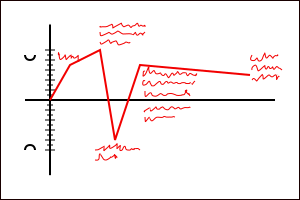
In effect, the UX curve is a collection of the user's memories about the product as remembered. It is highly subjective and focused on what the user remembers, as opposed to being a record of the product — the contents, times and results of events are all reported by the user after the fact (not recorded as it happens).
This makes the UX curve useful for determining user satisfaction, and how satisfaction changes over time.
Exercise
We prepared our own UX curves in the lecture. I was reporting my experience with a Scrikss mechanical pencil, whereas my classmates opted for electronic devices: a phone and a laptop. As a result, there were similarities in their curves that weren't present in mine:
-
Their curves had an overall downward trend. As electronic devices are intricate and often made with planned obsolescence, they deteriorated over time. My pencil also degraded, but it was able to function and over time, the wear gave it a well-used appearance.
-
They both had bad experiences with having their devices repaired. A pencil is not something you take to a repair shop, but I made modifications to mine and ended up with a more positive experience than before.
Conclusion
After the UX curve, I left informed about my experience. The curve showed both flaws in the product, and how the flaws affected my experience.