Coming up with ideas
Our interviews with our target users, although valuable, do not directly lead to a product. In order to find solutions to the problems they were experiencing, we use techniques alternating between divergent and convergent: generating large numbers of ideas, then using processes to develop, refine, and filter them.
For our project as part of this class, we used the following techniques:
- Brainwriting
(Divergent) - "Yes, And"
(Divergent) - Affinity mapping
(Convergent) - SCAMPER
(Divergent) - Dot vote
(Convergent)
(Green = divergent, red = convergent)
I already discussed affinity mapping in my last post. In this post, I hope to place it in the context of the whole ideation process.
Brainwriting & "Yes, And"
Brainwriting is actually quite simple — a (short) time limit is set, and everyone writes down any idea that comes to their mind. We do not think about whether the ideas are good at this point; they can be developed and discarded later on.
That is a good segue into the "Yes, And" technique, where everyone goes through the ideas that have been written and comes up with ideas that are specifically responding to them. Some benefits I noticed of using these two techniques together:
- We did not need to strain ourselves to generate a large number of ideas, as I would if we were working individually.
- Sometimes, we are too harsh on our ideas. When we hold an idea back based on our own judgment, the team misses out on comments others could have made on it. Such comments can develop the idea into something more usable, or serve as inspiration for more, ideas. Even if an idea is completely without merit, at least, writing it down and discarding it saves other team members the effort of coming up with the same idea and considering whether it's good. Writing every idea down saves on duplicate work.
We did not organize the ideas in this stage. Those that we wrote during "Yes, And" were not connected to the ideas they were responding to. This gave us freedom to sort them as we wanted during the affinity mapping stage.
SCAMPER
The way we used the SCAMPER method was actually quite similar to the "Yes, And" stage. SCAMPER is a way of generating ideas that works by applying the following transformations to existing ideas or products:
- Substitute: any aspect for another, including parts, processes or contextual factors like place or time
- Combine: ideas or products
- Adapt: an idea or product to a different context
- Modify: a product to improve it
- Put to another use: how something can be used for a different purpose or by a different user.
- Eliminate an idea, completely or an aspect of it. This actually also covers cutting costs or complexity.
- Rearrange the components of a whole.
Alex Osborn, the originator of the brainstorming method, originally came up with many of the questions used in the SCAMPER technique. However, it was Bob Eberle, an education administrator and author, who organised these questions into the SCAMPER mnemonic.
If only Bob could find a single word for "put to another use" that starts with P…
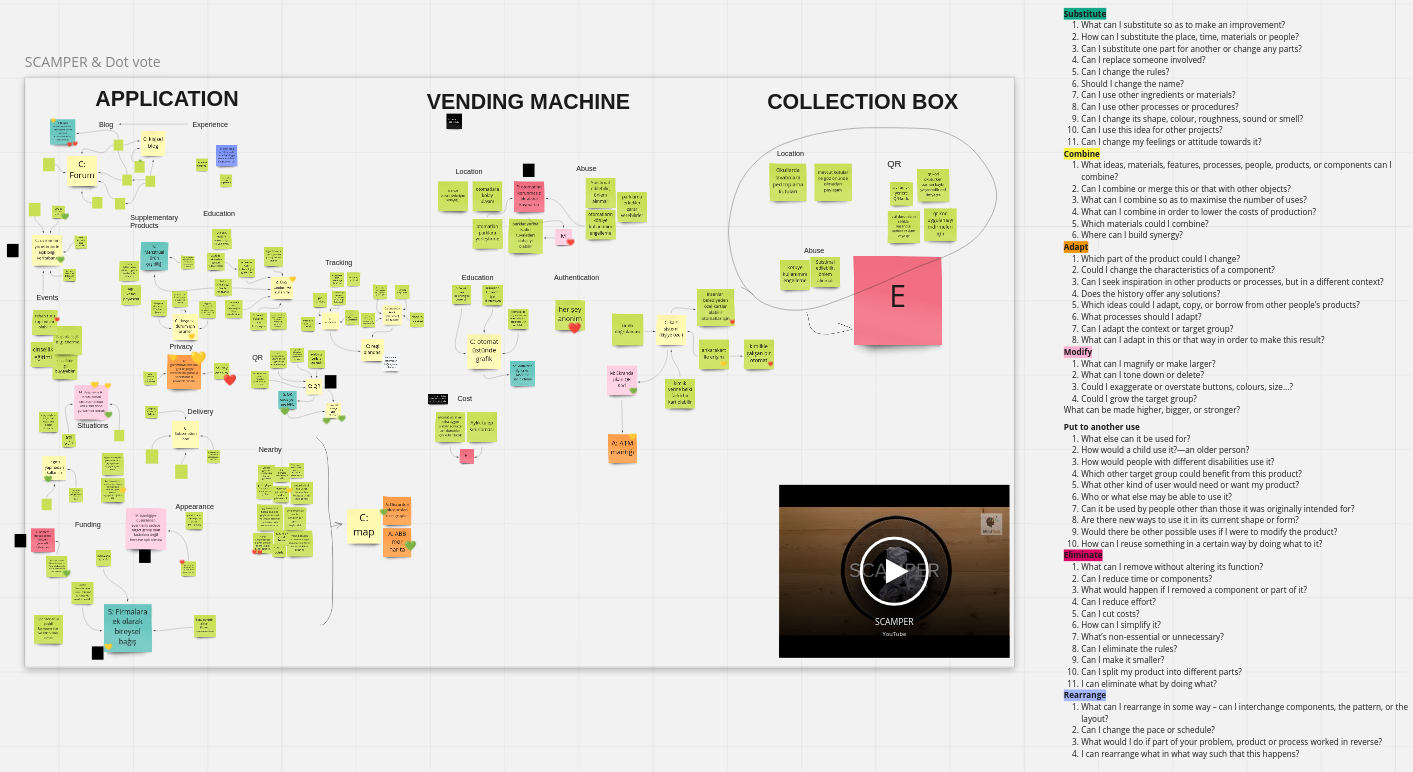
I definitely find SCAMPER beneficial. It's helpful to have a list of ways you can change an idea, which is generic enough to apply to your project but specific enough to actually guide you and speed up the ideation process.
Dot vote
In a dot vote, each person is given a bunch of colorful dots they can place on an idea. Multiple colors can be used with different meanings.
We used a traffic light color scheme with red for "no", yellow for "maybe" and green for "yes". Each person got three of each color. We also used heart emojis instead of dots, for no particular reason.
During the dot vote, we all found ourselves wishing that we had given ourselves more dots. In retrospect though, I think the restriction led us to think more deeply on the merits of each idea.
We coordinated a bit to make sure the ideas we all liked got more votes. Tactical voting seems like straying from the technique, but I don't think it caused any problems.
The dot vote also wasn't consequential. Some ideas were integrated into the system that had no votes at all. In effect, it felt like we had decided informally on which ideas to incorporate and the dot vote was a mere formality.